Discovering a Dunbar's Number for AI assistants
"The Oxford evolutionary psychologist Robin Dunbar is best known for his namesake "Dunbar's number," which he defines as the number of stable relationships people are cognitively able to maintain at once. (The proposed number is 150.) But after spending his decades-long career studying the complexities of friendship, he's discovered many more numbers that shape our close relationships."
— Atlantic, "You Can Only Maintain So Many Close Friendships" (2021)
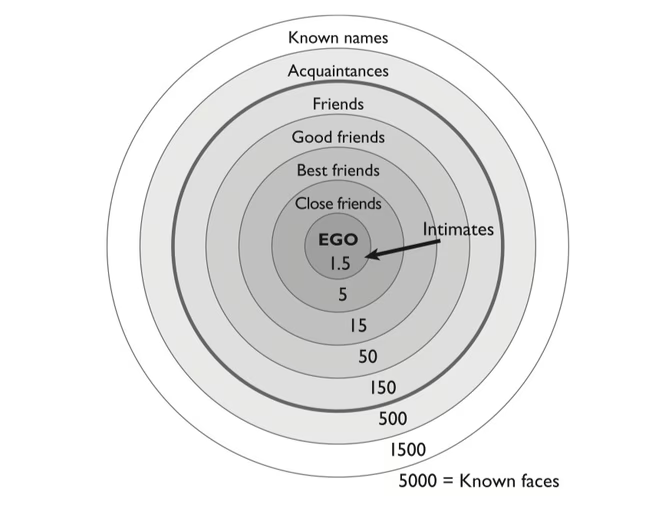
Oxford evolutionary psychologist Robin Dunbar spent his life studying the social lives of humans. It might be tempting to apply his learnings to the relationships between humans and AI. It's easy and convenient to anthropomorphize AI because it talks and sounds vaguely like humans. However, this would be misguided. AI is fundamentally a different kind of species.
AI assistants know so much. They are so smart. They never get tired. They can quickly skim vast amounts of text. At the same time, there are so many human experiences they can never experience. They never really experience heartbreak. They don't taste food. They don't live in apartments and feel their bodies age like humans do.
These differences create the grounds for fundamentally different kinds of relationships.
It's easy and convenient to take the position of deifying AI. To relate to it as one might relate to an omniscient God. In this view, we all only interact with one AI, say ChatGPT. It does everything for us. It's fungible intelligence personified. Having more than 1 AI evokes the image of a power nerd with 3 desktops at home simply because it's fun. Not something the masses would ever adopt.
I believe this viewpoint is misguided too. It's misguided because AI assistants can graduate beyond serving the role of "fungible intelligence personified", beyond serving a bundling of various consumer utilities. AI assistants are not just intelligence but rather intelligence wrapped up with a set of world views, a definition of cool, a definition of truth, an identity, a personality, etc. These non-fungible aspects of an AI assistant shape how it communicates information to us, how it teaches us, how it takes actions in the digital world. Given this, we will want to interact with at least a few different AI assistants on a daily basis. The amount of time we spend interacting with AIs each day is going to go dramatically up over the coming decade. It's going to be both impractical and psychologically burdensome to interact with a single AI for all that time.
While I am confident each of us will interact with more than 1 AI on a daily basis, I also acknowledge that we will likely interact with far fewer than the number of humans we interact with. The more people one has to interact with on a daily basis, the more transactional one must become with at least some portion of them. And being transactional doesn't feel good. Real relationships that we can invest in and where we feel seen feel good. I think this dynamic will play out with AI assistants. We won't want to interact with any AI in a transactional way unless we absolutely have to. This will be a headwind for brand-owned agents, but they'll be able to overcome it some of the time with unique competencies like differentiated supply (either of products/services or prices), specialized delightful experiences, or unique data flywheels.
Dunbar's Number for AI assistants is likely much less than 150, but it's certainly greater than 1.